Speed radar: buy, rent or use the cameras you already have
This piece describes Brazilian law — the Brazilian traffic code (Código de Trânsito Brasileiro, CTB), the Civil Code and the general data protection act (LGPD) — and the way gated communities are run in Brazil. It is not legal advice, and it does not describe the rules in force where you live. Check your own jurisdiction before acting on any of it. The physics and the engineering standards, on the other hand, are the same everywhere.
Short answer
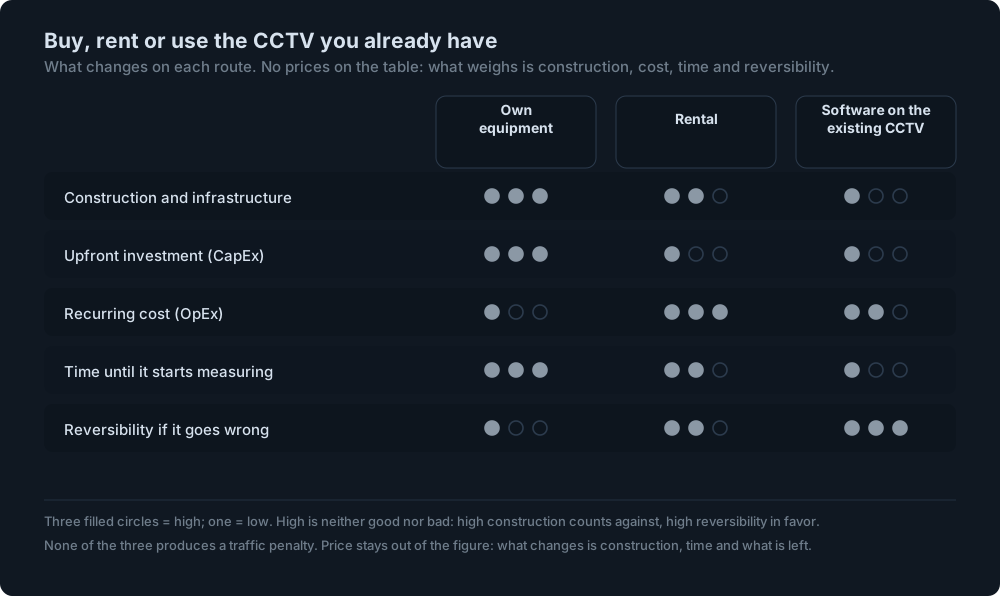
There are three routes, and none of them produces a traffic penalty. Owning the equipment trades recurring spend for an investment and for construction work: it delivers independence from any supplier and drops maintenance and obsolescence in the community's lap. Renting trades the investment for a monthly cost and a fast rollout, with one question to settle before signing: who keeps the evidence when the contract ends.
Software on the existing CCTV is the route with the least construction and the most reversibility, and the one that depends most on what is already installed: if the camera on that stretch does not have the framing, the position and the pixel density it needs, no software fixes that. The choice depends less on technology and more on three things — what the community wants to prove, how much construction it can take, and how long it is willing to stay tied to the decision.
In this piece
Does a speed radar in a gated community produce a traffic penalty?
No, and almost every badly calibrated expectation starts with that confusion. Brazil's traffic code (Código de Trânsito Brasileiro, CTB) requires an infraction proved by an electronic device to come from equipment previously regulated by CONTRAN, Brazil's national traffic council, inside a record of infraction identifying the body and the officer who issued it (art. 280 and § 2º), and requires the penalty to be applied by the traffic authority within its own jurisdiction (art. 281). A gated community is not a traffic authority.
What an internal measuring system delivers is something else: deterrence — the deviation stops being invisible — and evidence for the procedure the bylaws and the house rules already provide for. Anyone signing up in the hope of points on a driver's license will be disappointed by all three routes. What to do with that record is covered in can a gated community fine a resident for speeding?.
Owning the equipment delivers independence and charges you in maintenance
Buying has one advantage that is underrated at the HOA meeting: the asset belongs to the community, and the decision to carry on does not depend on renewing a contract with anyone. For a community that already manages building maintenance well, that is real.
What shows up later is the sum of the obligations that came with it. A dedicated point needs a physical structure, a reliable power supply and surge protection — anyone who has lost a gatehouse camera to a lightning strike knows that is not a theoretical scenario. It needs a routine: a dirty lens, a readjustment after the hedge is trimmed, an update, a spare part. And it needs a plan for the day the model is discontinued.
There is also a trap of scope: one point covers one stretch, the complaint is rarely about a single stretch, and every new stretch repeats the construction, the power and the maintenance. Before buying, work out how many stretches actually matter — a decision of diagnosis, not of purchase.
Renting trades the investment for contractual dependence
Renting solves two problems at once: it takes the upfront outlay out of the budget and it hands maintenance to whoever has the parts and the crew. For a community with no capital reserve, it is the route with the least political friction.
In exchange, the decision acquires a term and an owner. Three points deserve to be in writing before signing. The scope of support: what counts as a covered call, what the response time is and what is billed separately. The construction work: who carries it out, who pays for it and what happens to the infrastructure when the contract ends. And the most forgotten one: who owns the records and in what format they come out at the end. A sanction process that depends on a system the community has lost access to is a liability, not an asset.
Ask as well what happens if the supplier shuts down: the evidence in an open case has to outlive whoever produced it, and that depends on the file being self-contained and verifiable outside the system it came from.
Can you use the cameras that are already there?
Sometimes yes, sometimes no — and the answer is geometric before it is computational. Detail on the target is measured in pixels across the scene, not in the megapixels of the camera. The pixel density model based on IEC 62676-4:2014, as read by Axis, ties operational requirements to reference values: 25 px/m to detect, 63 px/m to observe, 125 px/m to recognize and 250 px/m to identify. The same camera meets one of those levels up close and fails all of them at the end of the street.
Position weighs as much as resolution. Eagle Eye Networks' application note AN033 is direct about it: the position of the camera plays a central role in the accuracy of a license plate recognition system. A wide-angle camera over a play area, mounted high and looking down, was installed to cover space, not to read a plate on a moving vehicle — and the honest answer is that the point does not do the job.
Other conditions do not show up in a quote and still decide the result: lighting at night, compression of the video stream, the stability of the network and of the recorder, and the real field of view after two years of vegetation. None of them is insurmountable; all of them have to be checked before signing. The arithmetic is in pixel density: the sum that decides what a camera can see.
OpenRadar is the third route: software that measures speed on private roads using the IP cameras the community already has, with no dedicated construction where the stretch is already covered. Where it is not, we say so before anyone signs — it is cheaper for everybody to find out during the assessment than at the first challenge.
How long does it take to start measuring?
It depends on how much construction the route demands — which is why the right question at the HOA meeting is not “when does it get installed?” but “what has to exist physically before it can be installed?”. Equipment at a new point depends on specification, purchase, structure, power and adjustment, and a delay in one link pushes the others. Renting shortens the specification and the purchase, but it does not remove the construction at the point. Software on an existing camera can be the fastest of the three, provided the camera on that stretch does the job — which is something to verify, not to assume.
This holds for all three: do not start with the contract. Start with the diagnosis of the stretch and with setting the limit and the procedure — measuring with no consequence defined produces a report and frustration. The practical order is in how to slow cars down inside a gated community.
| Criterion | Own equipment | Rental | Software on the existing CCTV |
|---|---|---|---|
| Type of spend | CapEx: an investment to acquire it, then maintenance. | OpEx: a recurring cost for the life of the contract. | OpEx, with the camera estate already paid for. |
| Construction and power | A pole or mount, power at the point, surge protection, cable runs. | The same work, carried out by a third party; part of it usually stays with the community afterwards. | None in the ideal case; work only if the stretch lacks a camera or the right framing. |
| Time to start | The longest: specification, purchase, construction, installation and adjustment. | Shorter than buying, still conditional on the work at the point. | The shortest of the three where the camera on the stretch already does the job; nil in construction. |
| Dependence on infrastructure | On the structure built for the point and on whoever maintains it. | On the supplier's infrastructure and on the contract being in force. | On the camera estate already installed on the stretch. |
| Reversibility and what is left at the end | Low. What is left is what was bought and installed, obsolescence included. | Medium, bounded by the term. What is left is whatever the contract leaves — including the answer to who keeps the records. | High. Stopping undoes no construction and leaves no idle asset. |
Five questions that settle the choice with no price on the table
- What do we need to prove? Only that someone exceeded the limit on that stretch, or which vehicle it was as well? The two requirements cost differently in framing and position.
- How many stretches? One isolated point and coverage of several internal roads are different projects, and the difference shows up in construction.
- How much construction can the community take right now? Work in a common area has a political cost on top of the financial one.
- What happens if we want to stop in a year? Reversibility is what separates a trial from a bet.
- Does the evidence outlive the supplier? If the file cannot be verified outside the system that produced it, the community has outsourced its own evidence.
What changes between the three routes is not the physics of the measurement — it is what is left afterwards: construction on the ground, a contract in force, or nothing.
One acceptance criterion that works for assessing any proposal, on any of the three routes: ask for a sample record produced on your stretch, and see whether someone outside the supplier can check it alone. A demonstration filmed somewhere else does not answer the question your HOA meeting is going to ask. What the defense usually says against a record is in recording an internal violation that holds up to challenge.
It carries no price, no price range and no cost comparison between the three routes, ours or anyone else's. The whole comparison here is operational — construction, maintenance, time, reversibility and dependence.
It does not claim that software on existing CCTV is always the best choice. Where the stretch has no camera with enough framing and detail, that route is not viable without intervention, and saying otherwise would be selling an expectation.
It does not claim that the pixel density values cited are a requirement for software. The pixel density model described by Axis on the basis of IEC 62676-4:2014 deals with operational requirements for a human observer and is, according to the source itself, a simplification that ignores factors such as the direction of the light, the quality of the optics and compression.
It does not describe the network, camera, calibration or operating requirements of any specific product, ours included.
Sources
- Brazil. Lei nº 9.503, de 23 de setembro de 1997 — Código de Trânsito Brasileiro (Brazil's traffic code, consolidated text), arts. 280 and 281. planalto.gov.br/ccivil_03/leis/l9503compilado.htm Basis for the statement that an infraction proved by an electronic device depends on equipment previously regulated by CONTRAN, inside a record identifying the body and the enforcement officer, and that the penalty is applied by the traffic authority within its own jurisdiction. Consulted on 4 September 2026.
- Axis Communications. Pixel density based on IEC 62676-4:2014, white paper. whitepapers.axis.com/en-us/pixel-density-based-on-iec-62676-4-2014 Source of the reference values of 25, 63, 125 and 250 px/m for detect, observe, recognize and identify, and of the caveat that the model is a simplification affected by the direction of the light, the quality of the optics and compression. Consulted on 4 September 2026.
- Eagle Eye Networks. Camera Installation Considerations for LPR/ANPR, application note AN033. een.com/docs/app-notes/an033/ Source of the statement that the position of the camera plays a central role in the accuracy of a license plate recognition system. Consulted on 4 September 2026.
We build the third route and we have an obvious interest in it — which is why this piece also describes where it fails. OpenRadar measures speed on private roads with the IP cameras already installed and signs every record with SHA-256, so that the resident can check the integrity of the file alone. It is not a radar certified by Inmetro/Contran and it does not issue traffic penalties.