Can a gated community fine a resident for speeding?

This piece describes Brazilian law — the Brazilian traffic code (Código de Trânsito Brasileiro, CTB), the Civil Code and the general data protection act (LGPD) — and the way gated communities are run in Brazil. It is not legal advice, and it does not describe the rules in force where you live. Check your own jurisdiction before acting on any of it. The physics and the engineering standards, on the other hand, are the same everywhere.
Short answer
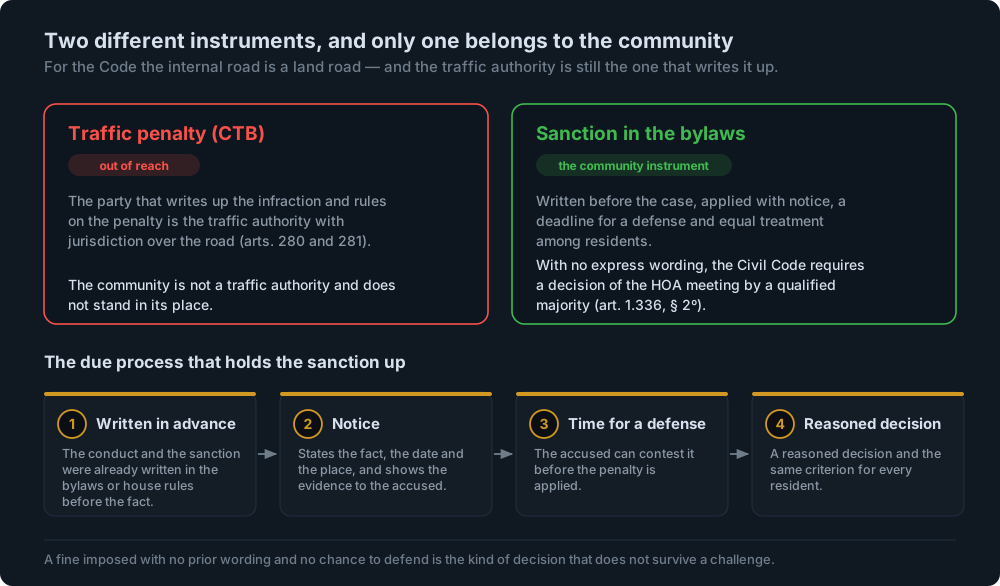
It can impose the fine set out in its own bylaws, not a traffic penalty. Brazil's traffic code (Código de Trânsito Brasileiro, CTB) treats the internal roads of communities made up of autonomous units as land roads (Lei 9.503/1997, art. 2º, parágrafo único), but the party that writes up an infraction and rules on the penalty is the traffic authority with jurisdiction over the road (arts. 280 and 281 of the same Code). A community is not a traffic authority and does not stand in its place.
The instrument it does have is a different one: the sanction set out in the community bylaws and the house rules, written before the case, applied with notice, a deadline for a defense and equal treatment among residents. With no express wording, the Civil Code requires a decision of the HOA meeting by a qualified majority before the fine can be charged (Lei 10.406/2002, art. 1.336, § 2º).
In this piece
For the Code the internal road is a land road — and the community still cannot write up an infraction
A wrong sentence goes around in every property managers' group: “the CTB does not apply in here”. It does, in the sense the Code itself defines. Art. 2º, parágrafo único, as amended by Lei nº 13.146/2015, treats as land roads, “para os efeitos deste Código” (for the purposes of this Code), also “as vias internas pertencentes aos condomínios constituídos por unidades autônomas” — the internal roads belonging to communities made up of autonomous units.
What does not exist is any power for the community to enforce and punish. The caput of the same art. 2º says that the use of a road is regulated by the body or entity with jurisdiction over it. Art. 280 requires the record of infraction to identify the body and the officer who issued it — or the device that proved the infraction, which § 2º makes conditional on prior regulation by CONTRAN, Brazil's national traffic council. Art. 281 closes the circuit: the party that rules on the record and applies the penalty is the traffic authority, within its own jurisdiction.
None of those three figures — traffic authority, enforcement officer, device regulated by CONTRAN — belongs to the community. An internal measuring system can be excellent technically and still produce no traffic penalty: what is missing is not measurement quality, it is administrative authority.
So where does the power to fine inside a community come from?
From the Civil Code and from the community's own documents. Art. 1.334 lists what the bylaws shall determine: among other things, the quorum for decisions of the HOA meeting (item III) and the sanctions the unit owners or occupiers are subject to (item IV). Item V points to the house rules, where the operating detail usually lives.
Carrying it out falls to the property manager: art. 1.348 makes him responsible for complying with and enforcing the bylaws, the house rules and the decisions of the HOA meeting (item IV), and for imposing and collecting the fines due (item VII). The chain is always the same — the bylaws create the sanction, the house rules describe how it works, the HOA meeting decides when there is no wording to rely on, and the property manager applies it. When one step is missing on paper, the next one has nothing to stand on.
| Traffic penalty (CTB) | Community fine (Civil Code + bylaws) | |
|---|---|---|
| Who applies it | The traffic authority with jurisdiction over the road, through an officer or a device regulated by CONTRAN (arts. 280 and 281). | The property manager, under art. 1.348, VII, within what the bylaws and the HOA meeting have set. |
| What it rests on | An offense defined in traffic legislation. | A sanction set out in the bylaws (art. 1.334, IV) or decided by the HOA meeting when there is no express wording. |
| Cap on the amount | Set in traffic legislation for each offense. | Up to 5 times the monthly dues in the case of art. 1.336, § 2º; up to five times for repeated breach (art. 1.337) and up to ten times in the situation of the parágrafo único of that article. |
| Quorum | Does not apply. | With no express wording, at least two-thirds of the remaining unit owners (art. 1.336, § 2º); three-quarters under art. 1.337. |
| Effect on the driver's license | Points and the other penalties set out in the Code. | None. It is a civil obligation between the unit owner and the community. |
Does a fine imposed with no basis in the bylaws hold up?
This is the point that sinks most charges in practice. Art. 1.336, § 2º, is explicit: the unit owner “pagará a multa prevista no ato constitutivo ou na convenção” — shall pay the fine set out in the founding instrument or in the bylaws — and, “não havendo disposição expressa, caberá à assembleia geral, por dois terços no mínimo dos condôminos restantes, deliberar sobre a cobrança da multa”: with no express wording, it falls to the general meeting, by at least two-thirds of the remaining unit owners, to decide on charging it. Either the sanction is already written down, or every case turns into a decision with a high quorum — which, in a large community, means most cases are never ruled on.
One point of reading changes the strategy. Items II to IV of art. 1.336, which § 2º refers to, deal with duties tied to the unit and to the building — the safety of the building, the façade, quiet enjoyment and health. Driving over the limit on a common road is not literally in there. That is why the usual basis for this conduct is the sanction the bylaws themselves set out (art. 1.334, IV) and, on repetition, art. 1.337. This is a reading of the statute, not a legal opinion: whoever writes or reviews the bylaws should do it with a lawyer.
Amending the bylaws depends on the approval of two-thirds of the votes of the unit owners (art. 1.351, as amended by Lei nº 14.405/2022). The house rules usually have a simpler amendment procedure, set out in the bylaws themselves. Hence the practical order: check whether the bylaws already authorize a sanction for breaching a rule on circulation and, if they do, spell out the limit, the notice and the procedure in the house rules — instead of opening an amendment to the bylaws for every subject.
Who answers for the violation: the driver or the owner of the unit?
The community's legal relationship is with the unit owner or occupier — art. 1.337 uses exactly those terms, and that is the person the HOA meeting can compel to pay. A visitor, a contractor or a delivery driver is not a party to that relationship: the charge falls on the unit, and the bylaws need to say so in as many words.
Two operational consequences. The notice goes to the unit owner even when someone else was driving — and he has to be able to raise that in his defense, because repetition weighs later. And the link between the fact and the unit is the vehicle, identified by its license plate, not the face of whoever was driving: identifying people from images for an internal sanction creates an unnecessary data protection problem. The data side is on the privacy page.
OpenRadar produces the record, not the penalty. It measures speed on private roads with the IP cameras the community already has and records the date, the time, the stretch and the vehicle in a file carrying a SHA-256 signature anyone can check. The decision to warn, to fine or to drop the case stays with the community, within what the bylaws and the house rules provide for.
What a violation notice needs in order to survive a challenge
The Civil Code sets the amount and the quorum, but it does not describe the procedure: that is left to the bylaws and the house rules. Writing it before the first case costs one meeting; writing it afterwards looks like a vendetta against whoever happens to be caught. A notice that survives a challenge brings together seven elements:
- The rule that was breached, with the article of the bylaws or house rules and the date of the decision that created it.
- The date, the time and the place of the fact, precise enough for the resident to defend himself.
- The identification of the vehicle and its link to the unit.
- The record that supports the fact, and how it can be checked.
- The deadline and the channel for a defense, stated in the notice itself.
- Who rules on the defense — the property manager, the board or the HOA meeting — defined beforehand, not case by case.
- The history, where there is a repeat offense, because that is what supports a firmer measure.
On the deadline, one benchmark for reasonableness: in traffic proceedings, art. 281-A of the CTB provides that the deadline for a preliminary defense shall not be shorter than 30 days, counted from the issue of the notice. That does not bind a community — it is a different legal regime — but it works as a reference: too short a deadline is the first argument of anyone trying to void the charge.
Why objective evidence shortens the argument
With no record, the HOA meeting rules on memory. The most common defense is not legal, it is factual: “that was not me”, “I was not going that fast”, “the gate attendant has it in for me”. None of those is answered with another impression. With a record carrying the moment, the place, the vehicle and a stated method, the conversation moves off “whether it happened” and onto “what to do about it”.
There is a second effect, more important for the property manager: an objective record protects the person applying the sanction as much as it presses the person receiving it, because it makes it possible to treat everyone by the same criterion and to show as much. Unequal treatment is what turns a legitimate fine into a fight at the HOA meeting. An independent check of the file can be done on the public verification page.
It is not legal advice. Bylaws and house rules vary from community to community, and reading a concrete case correctly is work for a lawyer.
It does not claim that there is settled case law requiring prior notice and a full defense for a community fine. We did not check court reports for this piece; what is here comes from the statute and from administrative practice. Notice and a deadline for a defense are described as good practice that reduces litigation, not as a requirement confirmed by a ruling.
It does not claim that driving over the limit in a common area falls under items II to IV of art. 1.336 of the Civil Code. The piece argues the opposite: the usual basis is the sanction written into the bylaws and, on repetition, art. 1.337.
It does not deal with civil liability for an accident inside the community, which is a separate subject from the internal power to sanction.
Sources
- Brazil. Lei nº 9.503, de 23 de setembro de 1997 — Código de Trânsito Brasileiro (Brazil's traffic code, consolidated text), arts. 2º, 280, 281 and 281-A. planalto.gov.br/ccivil_03/leis/l9503compilado.htm Source of the definition of a land road that includes the internal roads of communities made up of autonomous units, of the requirements for the record of infraction and for a device previously regulated by CONTRAN, of the traffic authority's power to rule within its own jurisdiction, and of the minimum 30-day deadline for a preliminary defense in traffic proceedings. Consulted on 4 September 2026.
- Brazil. Lei nº 10.406, de 10 de janeiro de 2002 — Código Civil (Brazil's Civil Code, consolidated text), arts. 1.334, 1.336, 1.337, 1.348 and 1.351. planalto.gov.br/ccivil_03/leis/2002/l10406compilada.htm Source of the mandatory content of the bylaws (sanctions, quorum and house rules), of the cap and the quorum for the community fine, of the treatment of repeated breach, of the property manager's powers and of the quorum for amending the bylaws. Consulted on 4 September 2026.
If your community already has the limit and the procedure written down, what is missing is the record that supports the notice. OpenRadar measures speed on private roads using the IP cameras already installed and signs every item of evidence with SHA-256, so that the resident can check the integrity of the file alone, without depending on us. It is not a certified radar and it does not issue traffic penalties.