How to slow cars down inside a gated community
This piece describes Brazilian law — the Brazilian traffic code (Código de Trânsito Brasileiro, CTB), the Civil Code and the general data protection act (LGPD) — and the way gated communities are run in Brazil. It is not legal advice, and it does not describe the rules in force where you live. Check your own jurisdiction before acting on any of it. The physics and the engineering standards, on the other hand, are the same everywhere.
Short answer
There are five levers for bringing speed down on the internal road of a gated community: change the geometry of the road, set a limit that matches how the road is used, warn the people who ignore it, measure in a way that can be checked, and hold all of that up as a rule of living together. None of them works alone for long.
Geometry and signage act at one point on the road; measurement and consequence act on the behavior of the people who drive there every day. A community that only installs a speed bump usually moves the problem to another corner instead of removing it.
In this piece
The problem is almost never the visitor: it is the same car, on the same stretch, every day
The complaint that reaches the property manager is rarely about one episode. It is about a pattern: the straight stretch between the gate and the last building, the hour when everyone leaves for work, half a dozen vehicles that always come through fast. An isolated episode is bad luck; a pattern is predictable — and what is predictable can be dealt with.
The World Health Organization, in Managing speed (2017), attributes to excessive or inappropriate speed about a third of road traffic deaths in high-income countries and up to half in low- and middle-income countries. Those are figures for public roads — but the physics of an impact is the same on both sides of the gate, and inside it there are people on foot and children on bicycles.
The five levers, and what each one actually does
WHO organizes speed management into five fronts: traffic calming, a limit matched to the function of the road, enforcement of that limit, technology built into the vehicle, and communication of the risk. Inside the wall they separate along two questions: where the measure acts, and how long the effect lasts.
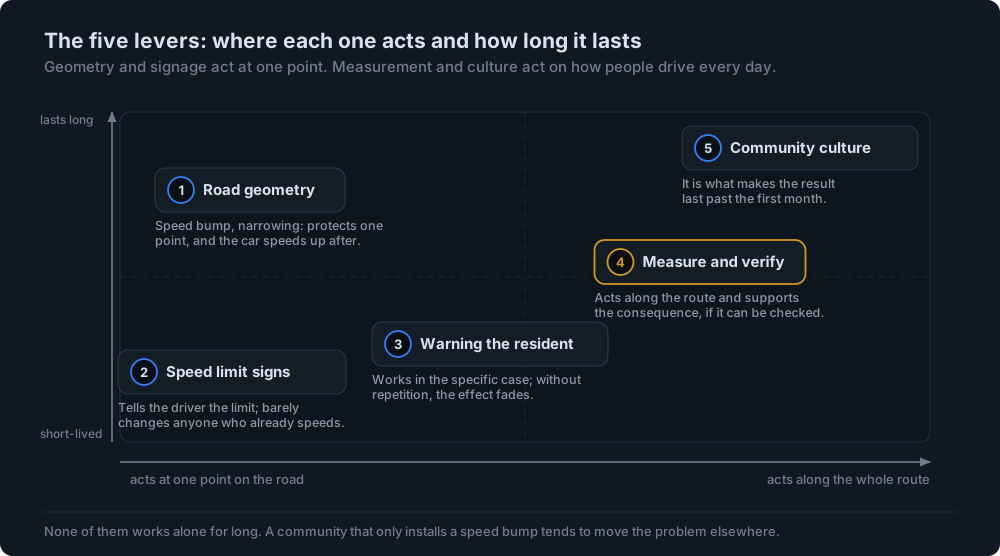
| Front | Where it acts | What it does not solve |
|---|---|---|
| Geometry of the road | At the exact point of the obstacle: speed bump, narrowing, change of surface, forced curve. | The stretch between obstacles. And it creates side effects: noise, discomfort, damage to low vehicles and to ambulances. |
| A limit that matches the use | On the driver's expectation, when the number fits what he sees on the road. | Nothing, if the limit is arbitrary. A 10 km/h sign on a 200 m straight is ignored, and it discredits the next sign. |
| Warning and consequence | On the behavior of someone who has already been warned once. | Nothing, if the warning does not come with a record. It comes down to one person's word against another's at the first challenge. |
| Measurement | On the sense that the deviation is visible and dated, along the whole stretch rather than at one point. | The decision. Measuring produces a record; the administrative measure is still the community's. |
| Communication and culture | On the buy-in of the majority, which is what keeps the rule alive the following year. | The minority who speed on purpose. A campaign with no consequence does not reach that group. |
Do speed bumps solve speeding inside a gated community?
They solve it at the point where they sit, and nowhere else. The hump imposes an immediate physical cost on the driver: come through fast and you feel it. Behavior changes for a few meters around the obstacle and goes back to what it was once the driver is past. A speed bump is a tool for protecting a place — a pedestrian crossing, a garage exit, a play area — and not for controlling a route.
Two side effects turn up months later. Route diversion: when one stretch becomes uncomfortable, part of the traffic moves to another internal road and the complaint reappears on a street that had no problem. And the erosion of acceptance: an aggressive bump brings complaints about vehicle damage, about noise and about emergency access — and the community starts arguing about the bump instead of about speed.
Before installing any physical element, record in the minutes the reason, the place and who approved it. An obstacle on an internal road is construction the community is responsible for, and the argument about damage to a vehicle or about ambulance access comes back with the first incident. Minutes written on the day of the decision cost nothing; minutes reconstructed two years later cost a lawyer.
Does a posted speed limit change the behavior of someone who already speeds?
Not much on its own, and less still when the number is not credible. A limit works as an anchor for expectation: the driver compares what the sign says with what the road seems to ask for. When the two agree, the sign is useful information. When they do not, he discards that sign — and starts discarding the others.
Choose the limit by looking at the stretch, not by copying the number from the community next door. A long straight with no crossing tolerates a higher limit than the blind curve by the gatehouse. One number per stretch is easier to defend than a single number for the whole community, because each one then has a justification of its own.
With no limit set in the bylaws, in the house rules or in a decision of an HOA meeting, there is no such thing as “excess” — there is an opinion about what counts as fast. That is the difference between “the car was flying” and “the car was above the limit for this stretch, set at the meeting of such and such a date”.
Does warning the resident work?
It works the first time and falls apart the second, if nothing is on record. The cycle is always the same: someone complains, the management company sends a generic circular to the whole community, the resident who speeds does not recognize himself in it, and the ones who do not speed feel unfairly told off. Two weeks later the complaint is back.
A warning that changes behavior is individual, dated and verifiable. Individual because a collective circular is noise. Dated because a repeat offense is what supports a firmer measure later. Verifiable because, when the resident pushes back, the argument needs an object that is not the memory of two people.
Does measuring speed inside the community change behavior?
Measuring makes the deviation visible and attributable. As long as nobody measures, speeding on the internal road is a decision with no consequence and no material witness. With measurement, the same decision starts leaving a trail — and the community gets an answer to the two questions almost nobody can answer today: how many vehicles go over the limit on that stretch, and at what time of day. With an answer, the HOA meeting decides on facts; without one, it decides on what the people who showed up had to say.
One caveat about what internal measurement is not. Brazil's traffic code (Código de Trânsito Brasileiro, CTB) treats the internal roads of communities made up of autonomous units as land roads (Lei 9.503/1997, art. 2º, parágrafo único, as amended by Lei 13.146/2015) — but the use of a road is regulated by the body with jurisdiction over it. A community is not a traffic authority: it does not write up infractions and it does not apply the penalties set out in the CTB. Its instrument is the bylaws and the house rules, and measurement enters as a documentary record for the measures those already provide for. The subject has a piece of its own.
OpenRadar measures speed on private roads using the IP cameras the community already has, and records every event with a SHA-256 signature anyone can check on their own, without going through us. It is not a certified radar and it does not issue traffic penalties: it is a documentary record for what the bylaws and the house rules already provide for.
Culture is what makes the effect last past the first month
Every new measure gets one good month: the bump startles people, the circular goes around, the residents' group talks about it. In the second month behavior settles back where it was — unless the rule has become part of how the community works. Three things make it last:
- Predictability. The same conduct leads to the same consequence, for the resident in the first building and for the board member's relative.
- Transparency. The aggregate number for the stretch on the notice board, with no names, showing whether it got better or worse.
- Reversibility. Saying that the measure will be reviewed on a set date takes the argument out of ideology and hands it back to results.
Where to start if the HOA meeting is next month
An order that works, with nothing to spend on the first two steps:
- Define the stretch. An agenda item about “speed in the community” decides nothing. An agenda item about a named stretch, with the peak hour identified, decides.
- Check what is already written. Bylaws and house rules: is there a limit, what measure is provided for a breach, what is the procedure for a defense. If none of that exists, that is the first item on the agenda — before buying anything.
- Choose the limit per stretch, with a justification. One number per geometry, not one number for the community.
- Set the procedure before the first case. Who notifies, within what time, through which channel, with what deadline for a defense and who decides. A procedure written afterwards looks like a vendetta.
- Only then decide about measurement. And decide at the same time what will be done with the record: measuring with no consequence defined produces data and frustration.
It does not claim how much speed drops at a given distance from a speed bump: we have no source for that number, and it depends on the geometry of the obstacle and of the road.
It does not claim that the WHO figures on road traffic deaths apply to the internal roads of a gated community. They are figures for public roads and they are here as a reference for the magnitude of the risk of speed, not as a statistic about gated communities.
It does not claim that measurement, on its own, lowers speed. What the piece supports is that measurement produces an attributable record; the effect on behavior depends on the consequence the community decides to apply.
It is not legal advice. The bylaws, the house rules and the procedure for a defense in each community are specific, and they should be read with a lawyer.
Sources
- World Health Organization. Managing speed, 2017 (WHO/NMH/NVI/17.7). who.int/publications/i/item/managing-speed Source of the contribution of speed to road traffic deaths (about a third in high-income countries, up to half in low- and middle-income countries) and of the list of five fronts of speed management. Consulted on 4 September 2026.
- World Health Organization / Global Road Safety Partnership. Speed management: a road safety manual for decision-makers and practitioners, 2008. iris.who.int/items/0b80fe8d-cf81-4a2f-ad82-4b3fe582d69c Reference manual on choosing a limit, traffic calming and enforcement. Consulted on 4 September 2026.
- Brazil. Lei nº 9.503, de 23 de setembro de 1997 — Código de Trânsito Brasileiro (Brazil's traffic code), art. 2º and parágrafo único (as amended by Lei nº 13.146/2015). planalto.gov.br/ccivil_03/leis/l9503compilado.htm Basis for the statement that the internal roads of communities made up of autonomous units count as land roads for the purposes of the Code, and that the use of a road is regulated by the body with jurisdiction over it. Consulted on 4 September 2026.
If your community reaches the measurement stage, the point that usually settles the argument is not the speed that was measured: it is whether the record survives a challenge. Every image OpenRadar produces carries a SHA-256 signature, and the resident can check its integrity alone, without going through us.