Speed bumps did not work: why drivers speed up again
This piece describes Brazilian law — the Brazilian traffic code (Código de Trânsito Brasileiro, CTB), the Civil Code and the general data protection act (LGPD) — and the way gated communities are run in Brazil. It is not legal advice, and it does not describe the rules in force where you live. Check your own jurisdiction before acting on any of it. The physics and the engineering standards, on the other hand, are the same everywhere.
Short answer
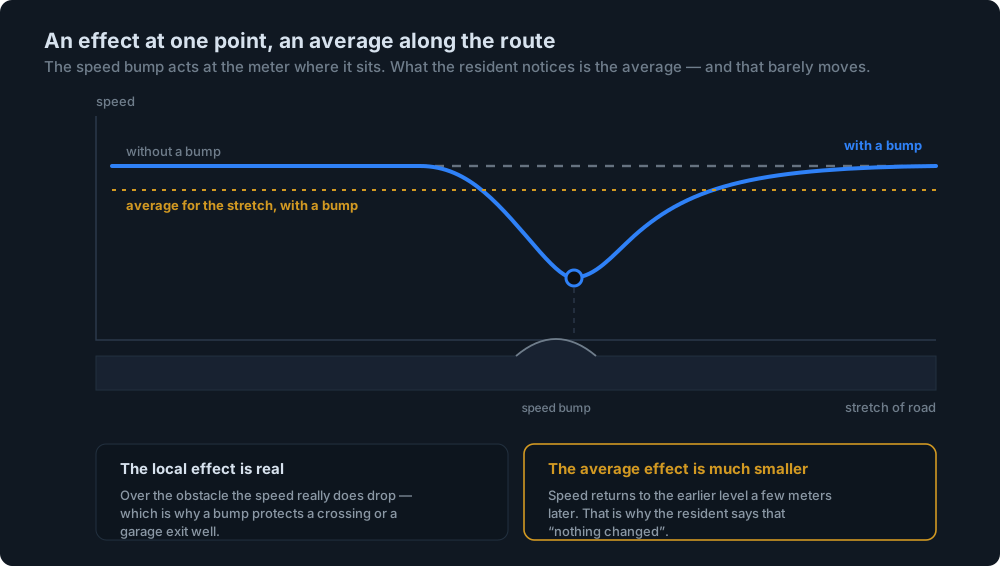
A speed bump imposes a physical cost on the driver at the meter where it sits, and behavior returns to what it was a few meters later. It is a treatment for one point — good for protecting a crossing, a garage exit or a play area — and not a treatment for a route. The resident reads that as “nothing changed”, because the average speed along the stretch is much the same.
The traffic calming literature does not assess a single bump: it assesses area-wide schemes, with a set of measures. The Cochrane review of area-wide traffic calming (Bunn and colleagues, 2003) brought together 16 controlled before-and-after studies and concluded that the intervention is promising but that more rigorous evaluation is missing. One hump in the middle of a straight is not that intervention.
In this piece
Speed is a problem of the route, and a speed bump is an answer at one point
The mechanism of a transverse hump is immediate: come through fast and you feel it in your body and in the car. That is why it does well what it sets out to do — if children cross between two buildings, an obstacle there protects exactly there, and that is a sound design decision.
The complaint that reaches the property manager, though, is almost never about a point. It is about a stretch: the straight between the gate and the last building, at the hour when everyone leaves for work. An isolated obstacle changes the speed profile around itself and hands the driver back to cruising speed as soon as it clears the mirror. The physical cost is over.
The World Health Organization, in Managing speed (2017), treats modifying the road as one of five approaches to speed management — the others being a limit matched to the function of the road, enforcement, technology built into the vehicle and communication of the risk. The same document attributes to excessive or inappropriate speed about a third of road traffic deaths in high-income countries and up to half in low- and middle-income countries. The list of five fronts is the warning that none of them solves the problem alone.
| Measure | Effect at the point | Effect along the stretch | The trade-off that shows up later |
|---|---|---|---|
| A single transverse hump | Strong and immediate. | Small. Speed returns further on. | Noise in the unit next door, discomfort, complaints about vehicle damage, traffic diverting to another internal road. |
| A sequence of obstacles | Strong at every point. | Larger, because it shortens the gap in which you can accelerate. | Multiplies noise, construction and maintenance; and it is where the nuisance to an ambulance or to an older resident stops being occasional. |
| Narrowing and a change of alignment | Moderate, through the sense of risk. | Moderate along the treated stretch. | Costs parking spaces and usable width; needs a design and does not fit every internal road. |
| A limit set per stretch | None on its own. | Acts on the driver's expectation when the number fits the road. | An arbitrary limit is ignored and discredits the next sign. |
| Measurement with a record | Indirect. | Acts along the whole stretch, because the deviation becomes visible and dated. | Produces a record, not a decision: with no consequence defined, it produces a report and frustration. |
Why does the car speed up again after the obstacle?
Because the obstacle did not change the reason he was speeding. The person who speeds on the internal road is usually late, knows the way by heart and does not expect to meet anyone at that hour. The bump adds a cost of two or three seconds, and no new information about risk beyond it.
Two effects reinforce the sense that nothing changed. Aggressive recovery: some drivers accelerate harder coming off the obstacle to win back the lost time, and the neighbor hears exactly that. And route diversion: when one stretch becomes uncomfortable, the traffic moves to another internal road and the complaint reappears on a street that had no problem.
What the literature shows is about a set of measures, not about one speed bump
This is where the argument at an HOA meeting tends to invent numbers. The Cochrane systematic review of area-wide traffic calming (Bunn, Collier, Frost, Ker, Roberts and Wentz, 2003) found no randomized trials: it covered 16 controlled before-and-after studies, carried out in Germany, the United Kingdom, Australia and the Netherlands, none of them in a low- or middle-income country. The outcomes measured were crashes, injuries and deaths, with significant heterogeneity between studies.
Two readings matter. What was assessed is an area-wide scheme — several coordinated measures across a network of residential streets — not one hump on one stretch. And the outcome is crashes and injuries, not “the car went by more slowly”. That evidence does not support saying that a new speed bump will bring down the average speed on your stretch.
The Cochrane review of speed enforcement detection devices (Wilson, Willis, Hendrikz and Bellamy, 2006) offers the contrast that matters here: of the 26 studies included, practically all recorded a reduction in average speed and in the proportion of vehicles above the limit, and the authors separate the effects in the vicinity of the measurement points from the effects across wider areas. It is the same logic as the speed bump — an effect concentrated where the measure exists — with one difference: a measurement point can cover a stretch; an obstacle covers a meter of road.
Does installing more speed bumps solve it?
Shortening the gap between obstacles increases the effect along the stretch, which is why traffic calming projects work with sequences rather than loose pieces. The problem is that every new piece brings the whole trade-off with it: more noise, more construction, more maintenance, more complaints about damage to low vehicles and more discomfort for someone with a bad back, for someone carrying a small child and for the stretcher in an ambulance. In a gated community, those complaints arrive before the results do.
It is worth reading art. 94 of Brazil's traffic code (Código de Trânsito Brasileiro, CTB) before approving the work. The parágrafo único reads “é proibida a utilização das ondulações transversais e de sonorizadores como redutores de velocidade, salvo em casos especiais definidos pelo órgão ou entidade competente, nos padrões e critérios estabelecidos pelo CONTRAN” — the use of transverse humps and rumble strips as speed reducers is prohibited, except in special cases defined by the competent body or entity, to the standards and criteria laid down by CONTRAN. Under the Code, a speed bump is a justified and standardized exception, not the default option. We do not claim here how that provision applies to an internal road — that is a question for the community's lawyer. The editorial point is another one: if the rule for public roads treats the obstacle as an exception, treating it as the first answer inside the gate deserves at least an argument recorded in the minutes.
OpenRadar exists for the part that is missing from this conversation: knowing what happens along the stretch, and not only at the meter where the obstacle sits. It measures speed on private roads with the IP cameras the community already has, and every record comes out signed with SHA-256 so that anyone can check it. It is not a certified radar and it does not issue traffic penalties.
The costs that show up months later
At an HOA meeting, the speed bump is the easiest measure to argue for: visible, tangible and with an immediate effect on perception. The items in the last column of the table above — noise, suspension damage, discomfort and ambulance access — only turn up months later, and nobody connects them to the original decision. Which is why it is worth recording in the minutes, on the day of the decision, the place, the justification and who approved it.
How do you know whether the speed bump worked?
By measuring before and after, on the same stretch, at the same time of day. Without that, the assessment turns into a mood survey: whoever now has to brake complains, whoever lives next to the crossing is grateful, and the HOA meeting decides for the group that showed up. Two objective questions settle almost the entire argument: how many vehicles go over the limit on that stretch, and in which time band.
Measuring also protects a decision already taken. If the obstacle improved the stretch, the number shows it and the complaint about noise loses force. If it did not, the community finds out before approving the second and the third hump.
It does not claim how much speed drops at a given distance from a speed bump, nor what the ideal spacing between obstacles is. We have no source for those values, and they depend on the geometry of the device and of the road.
It does not claim that the Cochrane reviews cited apply to the internal roads of a gated community. They deal with public roads, they measure crashes and injuries — not average speed along a private stretch — and the traffic calming one assesses area-wide schemes, not isolated obstacles.
It does not claim that a speed bump in a gated community is unlawful. We cite art. 94 of the CTB for what it says about public roads; how that provision applies to an internal road is a legal question we do not settle here.
It does not quantify vehicle damage, noise or ambulance delay. Those effects come up as recurring objections at HOA meetings; we have no source that measures them.
Sources
- Bunn F, Collier T, Frost C, Ker K, Roberts I, Wentz R. Area-wide traffic calming for preventing traffic related injuries. Cochrane Database of Systematic Reviews, 2003, CD003110. pubmed.ncbi.nlm.nih.gov/12535454/ Source of the statement that the review found no randomized trials, covered 16 controlled before-and-after studies in Germany, the United Kingdom, Australia and the Netherlands, measured crashes, injuries and deaths with significant heterogeneity, and concluded that the intervention is promising and needs more rigorous evaluation. Consulted on 4 September 2026.
- Wilson C, Willis C, Hendrikz JK, Bellamy N. Speed enforcement detection devices for preventing road traffic injuries. Cochrane Database of Systematic Reviews, 2006, CD004607. pubmed.ncbi.nlm.nih.gov/16625608/ Source of the statement that of the 26 studies included practically all recorded a reduction in average speed and in the proportion of vehicles above the limit, and that the review separates the effects in the vicinity of the measurement points from the effects across wider areas. Consulted on 4 September 2026.
- World Health Organization. Managing speed, 2017 (WHO/NMH/NVI/17.7). who.int/publications/i/item/managing-speed Source of the five approaches to speed management and of the contribution of excessive or inappropriate speed to road traffic deaths — about a third in high-income countries and up to half in low- and middle-income countries. Consulted on 4 September 2026.
- Brazil. Lei nº 9.503, de 23 de setembro de 1997 — Código de Trânsito Brasileiro (Brazil's traffic code, consolidated text), art. 94 and parágrafo único. planalto.gov.br/ccivil_03/leis/l9503compilado.htm Source of the quotation on the prohibition of transverse humps and rumble strips as speed reducers, except in special cases defined by the competent body to the standards laid down by CONTRAN. Consulted on 4 September 2026.
Deciding to install or to remove an obstacle gets much simpler when there is a number for the stretch instead of an impression from the corridor. OpenRadar measures speed on private roads using the IP cameras already installed and signs every record with SHA-256, so that any resident can check the integrity of the file alone.