Recording an internal violation that holds up to challenge

This piece describes Brazilian law — the Brazilian traffic code (Código de Trânsito Brasileiro, CTB), the Civil Code and the general data protection act (LGPD) — and the way gated communities are run in Brazil. It is not legal advice, and it does not describe the rules in force where you live. Check your own jurisdiction before acting on any of it. The physics and the engineering standards, on the other hand, are the same everywhere.
Short answer
An internal record is not argued over for being convincing: it is argued over for being contestable. As long as nobody challenges it, almost anything gets through. Once the defense does challenge it, the question stops being “is this image convincing?” and becomes a much harder one: can its authenticity be demonstrated to someone who does not trust the accuser?
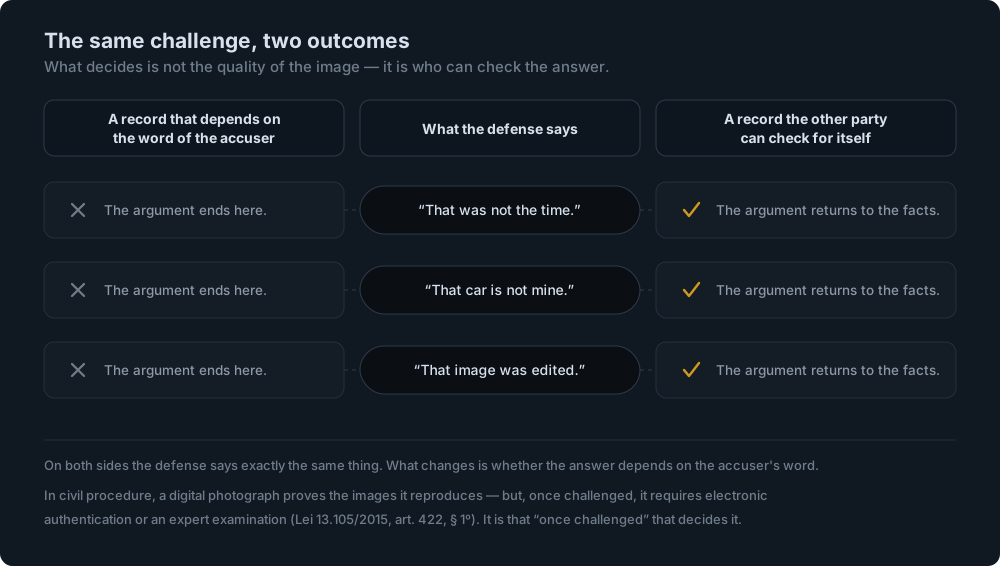
Civil procedure says as much in plain words: a digital photograph proves the images it reproduces but, once challenged, requires electronic authentication or an expert examination (Lei 13.105/2015, art. 422, § 1º). It is that “once challenged” that settles most arguments at an HOA meeting — and it is the same principle the community owes the accused when it opens a proceeding: the right to be heard, that is, to contest and to get an answer that is not the word of the person accusing.
In this piece
One person's word against another's is the natural state of almost every internal record
The typical case starts well: someone saw it, the gate attendant confirms it, the management company sends a notice. And then the resident answers with three sentences — it was not me driving, it was not at that hour, that photo shows nothing. Nobody gets anywhere, because all that exists is the memory of two people and an image with no context. The property manager backs off to avoid a fight, and the rule written into the bylaws loses authority for the next case.
The way out is not to accuse more firmly. It is to produce a record that answers those three sentences on its own — less technology and more discipline: deciding, before the first case, what the community treats as a valid record, and applying that criterion equally to everyone.
What does not work as a record?
Three formats turn up in almost every community and support nothing once they are challenged.
- A phone photo with no context. It does not say where it was, when it was or what was happening. The clock on the device can be changed by the person who took it, and the image carries no fixed element to anchor the place. It works as an internal heads-up, not as the basis for a sanction.
- A screenshot from a messaging group. It records that somebody said something, not that the thing happened. And it drags in content from third parties who have nothing to do with the case.
- An account from a third party with no record attached. A witness has value, but on its own it reproduces the original problem: two versions and no object. An account is there to start an investigation, not to close it.
The practical criterion is simple: if the record only stands because one person says it is true, it is not a record. It is testimony.
Does a digital photograph count as evidence?
It does, with one condition. Art. 422 of Brazil's code of civil procedure (Código de Processo Civil) gives any mechanical reproduction the standing to prove the facts it represents if its conformity with the original is not challenged by the party against whom it was produced. Paragraph 1 deals with the digital case: digital photographs prove the images they reproduce, “devendo, se impugnadas, ser apresentada a respectiva autenticação eletrônica ou, não sendo possível, realizada perícia” — if challenged, the corresponding electronic authentication has to be produced or, where that is not possible, an expert examination carried out.
Two consequences follow. As long as nobody challenges it, almost anything gets through — which is why so many management companies believe their process works, right up until someone decides to argue. And when the challenge comes, the question stops being “is the image convincing?” and becomes “is there electronic authentication for this file?”. Producing it later is expensive; producing it at capture is practically free.
The backdrop: art. 369 guarantees the parties the use of all lawful means to prove the facts, and art. 371 gives the judge a reasoned appraisal of the evidence. There is no mandatory format for proving an internal violation — there is what survives a challenge and what does not. Which is why it is worth looking not at a checklist of items, but at what the defense usually says and at the legal question each line raises.
| What the defense says | The legal question it raises |
|---|---|
| “That was not the time.” | Authenticity. As long as the only guarantee of when is the word of the accuser, the doubt is legitimate and nobody can dispel it in the meeting. |
| “That is not even in here.” | Relevance. If the scene is not tied to the common area of the community by something anyone can recognize, it does not prove the fact alleged. |
| “That car is not mine.” | Identification. Without tying the vehicle to a unit by something other than one person's recognition, the accusation lands on whoever somebody thinks it was. |
| “That thing does not measure anything.” | Soundness of the method. Whoever makes the claim has to be able to explain how they established it, in language the HOA meeting can follow, and to admit what the method does not reach. |
| “That image was edited.” | Integrity. This is exactly the challenge art. 422, § 1º, deals with: from there on, either there is electronic authentication or the road ahead is an expert examination. |
Notice what those five lines have in common: none of them argues with the image itself, all of them argue with who stands behind it. Which is why the useful answer is not a better image, but one the other party can check without depending on whoever produced it. The principle is far older than any technology: whoever makes a claim has to be open to verification by the person who disagrees.
Every record OpenRadar produces comes out with a SHA-256 signature anyone can check on their own, without going through us. A check only the accuser can run does not settle any argument.
A chain of integrity is what separates a record from any old file
A chain of integrity means being able to demonstrate that the file presented today is the one recorded on the day of the fact. The usual instrument is a cryptographic hash function: a fixed-length digest computed over the content, which changes completely if a single bit changes. Whoever receives the file recomputes the digest and compares. If it matches, the content is the same.
What that reaches has to be stated honestly, because confusion here produces overblown claims at HOA meetings. A hash does not prove when the image was made, does not prove that it depicts what is claimed and does not prove who produced it. It proves one thing only, and proves it well: that the file has not changed since the digest was computed. The moment, the place and the method are separate elements, each with a mechanism of its own — the subject has a whole piece to itself in video evidence that holds.
One operational detail settles a great many cases: who can run the check. Verification that depends on the community opening its own system and showing a screen is circular. What ends an argument is an independent check — the accused, his lawyer or an expert examining the file on their own.
Does the accused need a right to a defense?
In practice, yes — for a pragmatic reason. The Civil Code sets the amount and the quorum for a community fine, but it does not describe the procedure: that comes from the bylaws and the house rules. With no written procedure, every notice is improvised, and improvisation is the easiest argument for anyone trying to void the charge.
A minimum procedure fits in five lines of the house rules: who investigates, how long before the unit owner is notified, through which channel, what the deadline for a defense is, who rules and whether there is an appeal. Alongside it, a rule on retention: the record is kept for as long as the procedure lasts, and no longer.
Equal treatment is what keeps the rule standing at the next HOA meeting
A good record loses its value when it is used selectively. If three residents went over the limit on the same stretch and only one was notified, the argument stops being about speed and becomes about a vendetta — and on that ground the community loses, however impeccable the evidence.
Which is why the trigger has to be defined beforehand and apply to everyone: same stretch, same limit, same procedure, same sequence of warning and sanction. It is also what makes it possible to account for the results without exposing anyone — an aggregate number per stretch and per time band on the notice board, with no names, and the individual case kept inside the notice procedure.
It is not legal advice, nor an opinion on evidence. What holds in a concrete case depends on the bylaws, on the house rules and on a lawyer's assessment.
It does not claim that there is case law requiring a cryptographic signature on a record produced inside a gated community. We did not check court reports for this piece; what is here comes from the text of the Código de Processo Civil and from experience with challenges.
It does not claim that an integrity signature proves authorship, the date of capture or the truth of what the image shows. It proves only that the file has not been altered since the digest was computed.
It does not describe the internal capture, time synchronization or investigation procedure of any system, ours included. The piece is about the legal criterion that settles the argument, not about how a record is produced.
Sources
- Brazil. Lei nº 13.105, de 16 de março de 2015 — Código de Processo Civil (Brazil's code of civil procedure), arts. 369, 371 and 422. planalto.gov.br/ccivil_03/_ato2015-2018/2015/lei/l13105.htm Source of the quotation on a challenged digital photograph requiring electronic authentication or an expert examination (art. 422, § 1º), of the rule that a mechanical reproduction proves the facts if it is not challenged (art. 422, caput), of the freedom of means of proof (art. 369) and of the judge's reasoned appraisal of the evidence (art. 371). Consulted on 4 September 2026.
- Brazil. Lei nº 10.406, de 10 de janeiro de 2002 — Código Civil (Brazil's Civil Code, consolidated text), arts. 1.334, 1.336 and 1.337. planalto.gov.br/ccivil_03/leis/2002/l10406compilada.htm Basis for the statement that the Civil Code sets the sanctions, the cap and the quorum for the community fine and leaves the procedure to the bylaws and the house rules, without describing it. Consulted on 4 September 2026.
We solve one specific piece of this problem: measuring speed on private roads with the IP cameras the community already has and signing every record with SHA-256, so that anyone can check the integrity of the file alone. The decision to warn, to fine or to drop the case stays entirely with the community, within what the bylaws provide for.