The real causes of false positives in AI video surveillance
Short answer
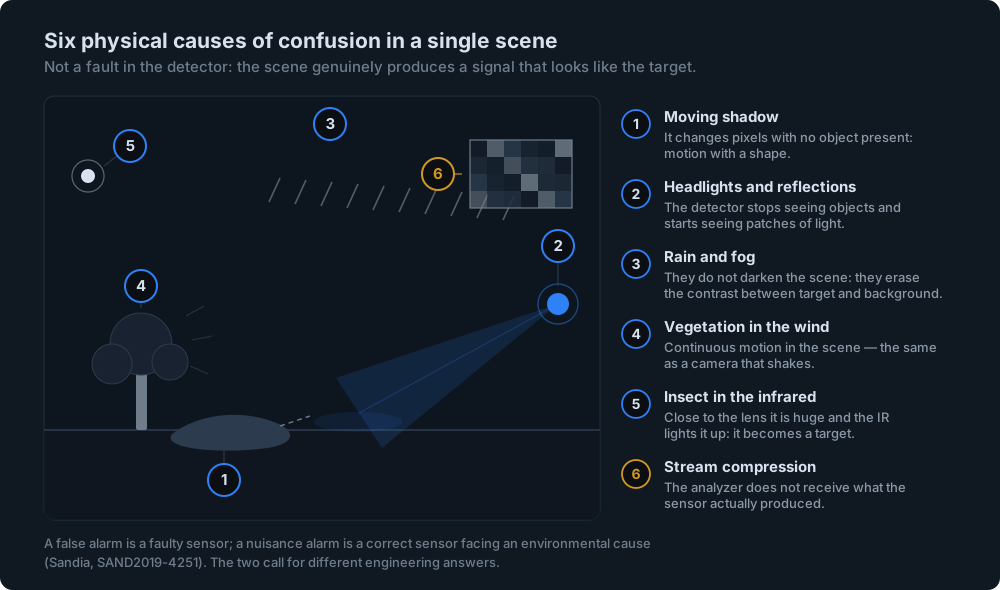
Most unwarranted alarms in video surveillance with artificial intelligence do not come from a faulty detector: they come from the scene genuinely producing a signal that looks like the target. Among the common causes in perimeter protection, Axis Communications lists animals, plants and trees in motion and severe weather, and names moving shadows, beams of light, small animals and insects as common triggers.
Two cases usually get called by the same name. In a Sandia National Laboratories report on the alarm station, a false alarm is the sensor working badly, and a nuisance alarm is the sensor working correctly in the face of an environmental cause — rain, wind, an animal. The two call for different engineering answers.
In this piece
A false alarm and a nuisance alarm are not the same thing
The distinction sounds bureaucratic and is not. An alarm from a faulty sensor is fixed with maintenance; an alarm from a leaf in the wind has nothing broken to fix. Sandia's report SAND2019-4251 places that decision among the hardest at the post: faced with an alarm, the operator has to say whether it is a scheduled alarm, a nuisance alarm, a false alarm or a threat — a choice that, according to the document, involves a great deal of uncertainty about extremely rare relevant events. That is why this piece is organized by physical cause: brand and model change; shadow, light, water and wind do not.
Why does a moving shadow fool a detector?
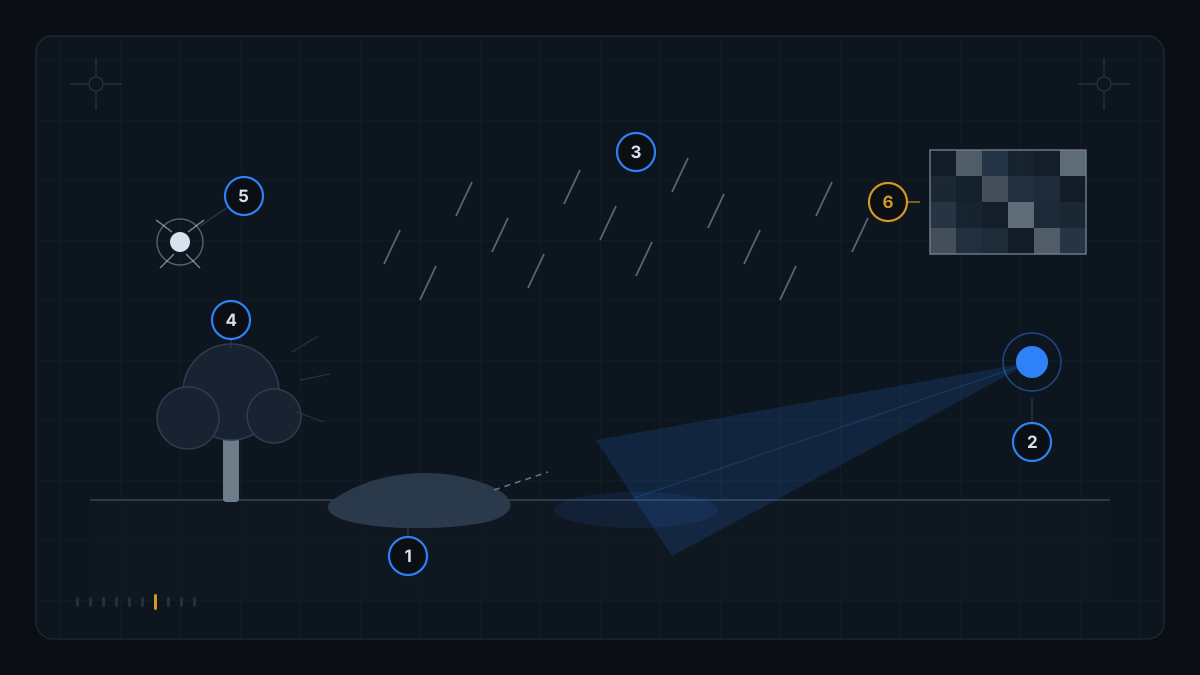
Because a shadow has almost everything an object has, except volume: it appears where there was nothing, it has a defined outline, it moves continuously and it changes the brightness of a whole region at once. For any method that depends on what changed between one instant and the next, it is indistinguishable from a dark body moving across the ground.
And a cast shadow is large: a pedestrian at the back of the scene takes up few pixels of height, and their shadow, stretched by a low sun, takes up several — the false signal comes through stronger than the real one. What the shadow lacks is volume: it has no relief, no temperature of its own, and it does not exist without the light source that casts it.
At night the detector stops seeing objects and starts seeing patches of light
A visible-light camera needs light to form an image — Axis repeats that point in its document on perimeter protection. At night the contrast comes from the light sources, not from the objects, and the scene turns into a set of patches that appear, move and vanish. Worse: the patch from a headlight is projected onto a surface at a different distance, and it can show up in a zone of interest the vehicle never entered.
Rain and fog do not darken the scene: they erase contrast
Water in the air does not block the image: it scatters the radiation. The Axis document on thermal cameras describes two mechanisms — absorption, in which water vapor and carbon dioxide retain part of the energy, and scattering, in which the radiation disperses on meeting droplets. Scattering weighs more, and the loss depends on the size and the concentration of the droplets.
| Condition | Attenuation | Practical reading |
|---|---|---|
| Urban pollution | 0.5 dB/km | Small effect over short distances. |
| Light rain | 4 dB/km | Noticeable loss over a long scene. |
| Heavy rain | 11 dB/km | Large droplets, low concentration. |
| Fog | 10 dB/km | Small droplets, high concentration. |
| Dense fog | 80 dB/km | Worst case in the table, by a wide margin. |
Axis works the example through: an attenuation of 3 dB means that only half the energy emitted by the object reaches the sensor, which pulls down the signal-to-noise ratio and degrades the reliability of the built-in video analytics. Add close-range rain to that: a droplet lit near the lens is a bright, fast, out-of-focus object — it does not look like a person, but it does look like motion.
Vegetation in the wind and a camera that shakes produce the same error
Axis puts the two cases into a single recommendation, because they are the same phenomenon seen from two sides: keep out of the scene any branches and flags that move in and out of the frame when the wind picks up, and mount the camera as firmly as possible, with sharp edges outside the framing.
A sharp edge just outside the scene can set off a false motion alarm if the camera shakes in the wind and shifts the framed scene over that edge. Since what moved was the camera, it reads the altered image as motion in the scene, even though nothing other than the camera itself has moved.
Axis Communications, Thermal cameras, October 2021 — paraphrase
A loose mount turns a windy day into a night of alarms. It is the cheapest cause on the whole list to fix, and the one that survives longest because nobody suspects it: the repair belongs to the bracket, not to the model.
Why do insects and spiders in the infrared set off so many alarms?
This is the most underrated cause, and Axis records it: small animals and insects are among the common triggers of a video system. The reason is optical and geometric. The infrared illuminator sits in the camera housing, so an insect a few centimeters from the lens takes the whole beam, sends back far more light than anything at the back of the scene, and occupies a huge fraction of the frame. A spider that spins a web in front of the dome produces, every night, a white, large and erratic object against a dark background.
Here pixel density works against the system, for the reason set out in pixel density and DORI: the insect does not fool the detector by looking like a person, but by being, in the image, larger than one.
The stream the analyzer receives is not what the sensor produced
A false positive can also be born of a network decision: analytics software commonly consumes the camera's secondary stream, at lower resolution and bitrate. Axis notes that analysis performed on the camera itself can work on uncompressed video, because compression only enters when transferring to a central server. A 2022 study on H.264 compression and object detection (arXiv:2211.05805) measures the cost: performance degrades appreciably at high compression, above all with poor light and fast targets — the very conditions in which the earlier causes were already at work. The CRF values from that study are in pixel density and DORI.
What does a false positive cost?
It costs the confidence of whoever is operating. The Sandia report names the risk: the interface has to let the operator tell a faulty sensor from an environmental cause, without inducing a low-prevalence effect so strong that they start dismissing alarms automatically, without judging them. The same document reports an informal test — one engineer at the interface while another triggered sensors at the rate of one alarm every five seconds. He was overwhelmed just acknowledging each alarm. This was not an attack scenario; it was the volume.
That is why raising sensitivity is almost never the answer. A system that alarms a lot and gets it right rarely converges on a system nobody looks at — and a system nobody looks at has an effective detection rate of zero.
Our work starts with a diagnosis of the scene, not with tuning the detector: which causes from this list that particular camera will meet, at what time of day, and whether its geometry supports the decision the client wants to automate. When the answer is that it does not, we say so before installing anything.
What countermeasures exist at the level of principle?
There is no universal filter, and anyone promising one ought to explain which cause it works against. Each phenomenon on this list fails for a reason of its own — optical in one case, geometric in another, network-related in the last — and so each calls for different treatment. A system that faces all of them with the same sensitivity knob is not filtering anything: it is only choosing between alarming too much and not alarming at all.
The public literature gives the direction, not the recipe. In listing the information an operator needs in order to decide the cause of an alarm, the Sandia report describes what an automatic system also has to weigh, calls orthogonal sensors the data that are not affected by the same cause as the nuisance, and insists that the algorithm present confidence and uncertainty in a way the operator can understand. That is a good bearing. It is not a design.
What separates the bearing from the design — which checks are worth running against which cause in that particular scene, with what weight, and at what point the record stops supporting an automatic decision — comes out of no paper. It comes out of the field: the same camera watched across the seasons, the hours and the weather of that place. That is why our answer to “do you filter false positives?” is always a diagnosis of the scene, and never a list of tricks.
It does not claim any percentage of false positives, nor of false-positive reduction. We found no verifiable public figure for the rate of unwarranted alarms in AI video surveillance under Brazilian conditions, so we quote none.
It does not claim how long it takes for a human operator's attention to degrade. There is literature on that, but we could not open and check the full text of the primary sources, so we describe only what the Sandia report puts in writing.
It does not describe any threshold, parameter, order of checks or calibration procedure used by OpenRadar. The countermeasures here are at the level of principle, and they come from public third-party documents.
It does not claim that a thermal camera or a radar solves the problem. Axis itself records that thermal does not deliver the forensic detail of a visible-light camera, and that the two technologies work better integrated than as substitutes for one another.
Sources
- Axis Communications. Perimeter protection with intelligent surveillance (white paper), July 2021. whitepapers.axis.com/en-us/perimeter-protection-with-intelligent-surveillance Source of the list of common causes of false positives (animals, plants and trees in motion, severe weather), of the mention of moving shadows, beams of light, small animals and insects as common triggers, of the statement that visible-light cameras need light, and of the observation that analysis at the edge works on uncompressed video. Consulted on 4 September 2026.
- Axis Communications. Thermal cameras (white paper), October 2021. axis.com/dam/public/1c/66/25/thermal-cameras-en-US-350481.pdf Source of the explanation of absorption and scattering, of the attenuation table by weather condition, of the 3 dB example and of the installation recommendation about branches, flags and a camera shaking in the wind. Consulted on 4 September 2026.
- Speed, Ann. Portable Intrusion Detection System Alarm Station Operator Interface Improvements. Sandia National Laboratories, report SAND2019-4251, March 2019. osti.gov/servlets/purl/1762330 Source of the distinction between a false alarm and a nuisance alarm, of the operator's decision between a scheduled alarm, a nuisance alarm, a false alarm or a threat, of the risk of operators dismissing alarms without judging them, of the test with one alarm every five seconds and of the requirements on spatial-temporal coherence, size and orthogonal sensors. Consulted on 4 September 2026.
- O'Byrne, M.; Sugrue, M.; Vibhoothi; Kokaram, A. Impact of Video Compression on the Performance of Object Detection Systems for Surveillance Applications, 2022. arXiv:2211.05805. arxiv.org/pdf/2211.05805 Source of the degradation of detection performance at high compression, poor light and fast targets. The CRF values from the same study are set out in the post on pixel density. Consulted on 4 September 2026.
We work on the IP camera that is already installed, with analysis at the edge and evidence signed with SHA-256 that anyone can check on their own. The false positive is the central problem of this kind of system, and we treat it as a problem of scene and geometry before treating it as a problem of the model.